 Nexus Darknet Market
This material was created exclusively for educational and research purposes. It does not publish links, addresses, mirrors, or instructions for accessing any platform — and never will. All information comes from open sources.
- 1. Why Does Nexus Market Appear in Threat Intelligence Reports?
- 2. What Kind of Marketplace Is Nexus Market?
- 3. How Does a Platform Like Nexus Market Operate Behind the Interface?
- 4. What Criminal Trade Flows Through Nexus Darknet Markets?
- 5. What Are the Risks of Platforms Like Nexus Market?
- 6. Why Do Darknet Markets Like Nexus Market Keep Appearing?
- 7. How Should Businesses Respond If Their Data Appears on Such a Platform?
- 8. Frequently Asked Questions
1. Why Does Nexus Market Appear in Threat Intelligence Reports?
The short answer: because of what it represents, not because of its size. Nexus Darknet Market belongs to the wave of universal dark web markets that absorb vendors and buyers after major takedowns. When a large platform falls — as Hydra did in April 2022, as Genesis Market did during Operation Cookie Monster in April 2023 — the criminal supply chain does not stop. It reroutes, and universal marketplaces like Nexus are where storefronts are restored fastest.
Analysts watch such platforms for a practical reason: migrating vendors carry their goods with them. Stolen accounts, stealer logs, card data, and fraud tooling that were sold on a seized market reappear on successor venues within weeks, often under the same aliases. Tracking where known vendor names resurface is one of the most reliable ways to map how the underground economy reorganizes.
2. What Kind of Marketplace Is Nexus Market?
Based on open researcher data, Nexus Market is structured like a conventional online store transplanted into an anonymity network. Every nexus market link leads to the same hidden service infrastructure:
- Universal catalog. Listings span digital goods (accounts, credentials, databases), fraud tools, cyber services, and a physical contraband segment — the standard spectrum of darknet demand.
- Escrow settlement. A third-party fund freeze until delivery is confirmed, designed to reduce direct buyer fraud — and simultaneously creating a centralized money pool that can be stolen or seized.
- Reputation layer. Vendor ratings and reviews substitute for identity verification; like everywhere underground, these signals can be inflated, purchased, or abandoned.
- Cryptocurrency payments. Settlement in Bitcoin and privacy-oriented coins, with internal exchangers lowering the entry barrier for new buyers.
None of these mechanics make the platform “safe” for participants — they make criminal trade more convenient to organize, which is precisely why law enforcement and defenders study them.
3. How Does a Platform Like Nexus Market Operate Behind the Interface?
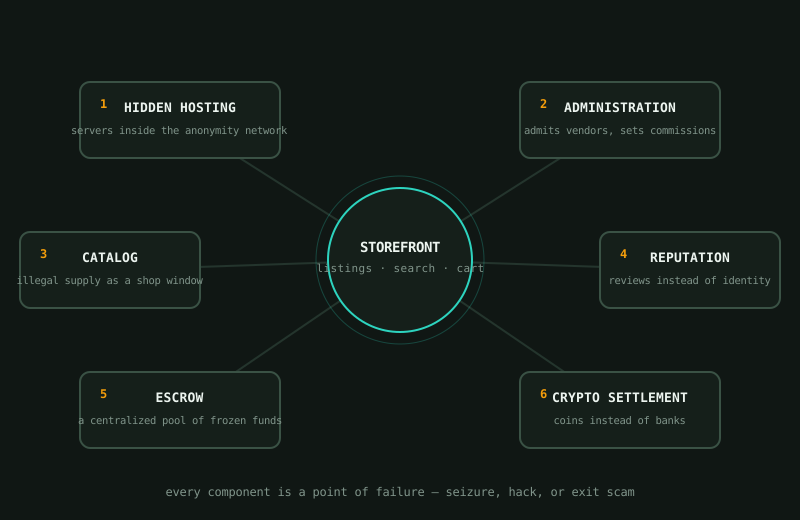
Under the storefront, six components keep the machine running — and each is a point of failure.
Hidden Hosting
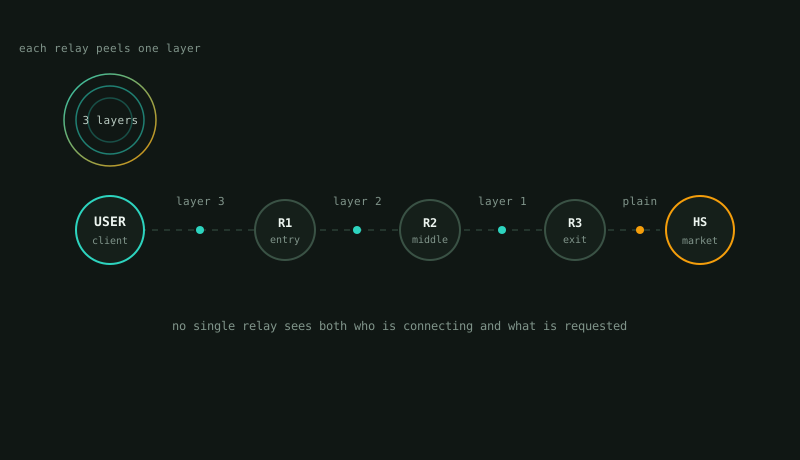
A nexus market onion address routes traffic through multiple relays before reaching the origin server, concealing location from investigators and users alike. Outages breed chaos: cloned pages, phishing copies, fake “mirrors.”
Administration
A small team controls registrations, vendor admission, commissions, and dispute outcomes. One arrest, hack, or exit scam can destroy the platform's trust in hours.
Catalog and Search
Illegal supply is packaged into familiar product categories — stolen data becomes a comparable, searchable shop window.
Reputation System
Reviews replace verification and are just as easy to fake; paid promotion and disappearing vendors turn trust signals into traps.
Escrow
Protects buyers from direct fraud but concentrates funds in one place — an irresistible target for both operators and attackers.
Cryptocurrency Settlement
Bypasses banks and payment controls, yet wallet reuse, exchange deposits, and laundering mistakes let blockchain analytics reconstruct money trails.
4. What Criminal Trade Flows Through Nexus Darknet Markets?
Five categories of criminal goods flow through Nexus Market: stealer logs, stolen accounts, card data, fraud tooling, and initial access credentials. The assortment of universal mini-markets maps directly onto business risks:
| Segment Sold | Typical Content | Resulting Harm |
|---|---|---|
| Stealer logs | Session cookies, saved credentials from infected devices | Account takeover within hours of posting |
| Stolen accounts | Banking, e-commerce, corporate SaaS logins | Fraudulent payments, data theft |
| Card data | Card numbers with CVV, full identity kits | Carding, chargebacks |
| Fraud tooling | Phishing kits, checkers, spam infrastructure | Scaled downstream fraud |
| Initial access | VPN/RDP credentials, corporate network entry points | Intrusions, ransomware preparation |
The speed of this pipeline is the key fact for defenders: valid sessions from fresh stealer logs are reused within the first hours, long before victims notice anything. This is why anti-fraud and IAM teams treat every new mini-market as a potential early-warning source, regardless of its size.
5. What Are the Risks of Platforms Like Nexus Market?
The risks fall into five categories: legal exposure, financial loss, identity exposure, scams and phishing, and downstream business impact for organizations.
- Legal exposure. Buying, selling, or knowingly participating in trade on such a platform can trigger a criminal investigation; accounts, correspondence, and payments all leave traces.
- Financial loss. Escrow balances and crypto deposits vanish in exit scams and shutdowns, with no recourse — a recurring script in underground trade.
- Identity exposure. Reused aliases and poor operational security link underground activity to real people, especially after servers are seized and their contents examined.
- Scams and phishing. Clone sites imitating popular markets steal credentials and funds; anonymity makes recovery impossible.
- Business impact downstream. For organizations, the real damage is not the marketplace itself but what leaked data enables later: account takeover, payment fraud, and network intrusions built on purchased access.
6. Why Do Darknet Markets Like Nexus Market Keep Appearing?
They keep appearing because law enforcement removes individual platforms but the underlying demand and supply remain intact. The lifecycle is predictable and well documented. Law enforcement operations — AlphaBay and Hansa in July 2017, Hydra in April 2022, Genesis Market in April 2023, Kingdom Market in December 2023 — remove individual platforms, but demand and supply remain. Displaced vendors need a storefront; displaced buyers need a venue; entrepreneurial operators supply both. The result is a continuous churn of successor markets, each a little smaller, a little quieter, and a little harder to monitor than the last.
This is why analysis of platforms like Nexus matters more than headline names: the quiet platforms are where fresh leaks circulate longest before reaching public attention.
7. How Should Businesses Respond If Their Data Appears on Nexus Market or a Similar Platform?
- Verify the leak — confirm authenticity and scope through an incident response provider or threat intelligence feed.
- Force credential resets for all potentially exposed accounts, prioritizing email, banking, and administrative access.
- Revoke active sessions — stolen session cookies bypass passwords, so resetting alone is not enough.
- Review access logs for signs of misuse: impossible travel, unusual IPs, new devices.
- Tighten anti-fraud rules — raise scoring thresholds for high-risk actions (payouts, password changes, new payees).
- Assess notification obligations with legal counsel, and monitor for secondary exposure as the data resells across other venues.
Speed matters more than attribution: by the time a leak makes headlines, the accounts are usually already under attack.
8. Frequently Asked Questions About Nexus Market Darknet
Is Nexus Market legal?
Darknet marketplaces of this type are used to trade stolen data, fraud tools, and other illegal materials. Buying, selling, or knowingly participating can lead to criminal investigation and prosecution.
Is Nexus Darknet Market safe to use?
No underground marketplace is safe: funds disappear in exit scams, clone sites harvest credentials, and participation itself creates legal and identity risks. This article does not provide and will never provide access instructions.
What is sold on Nexus Market?
According to open researcher data, the catalog combines digital goods (stolen accounts, stealer logs, databases), fraud tools, cyber services, and a physical contraband segment — typical of universal mini-markets.
Why do threat intelligence teams monitor Nexus Market?
Because migrating vendors resurface there after major takedowns, making such platforms leading indicators of where the criminal supply chain is moving — and where fresh leaked data will appear next.
Can cryptocurrency payments on such markets be traced?
Yes. Wallet reuse, deposits into regulated exchanges, and laundering mistakes allow blockchain analytics to reconstruct money flows — a technique used in multiple successful law enforcement operations.
What should I do if my company's data shows up on a darknet market?
Verify, reset credentials, revoke sessions, review logs, engage incident response, and assess legal notification obligations. Early action beats attribution.
This material was created exclusively for educational and research purposes. We have no connection to Nexus Market or any similar platform, their owners, administrators, vendors, or users. We do not support, advertise, or encourage visiting such resources or engaging in any illegal activity.
This article deliberately does not publish links, addresses, mirrors, or instructions for accessing any platform. All information comes from open sources: law enforcement publications, cybersecurity reports, and public research. The material is intended for information security professionals, analysts, journalists, and anyone seeking to understand the criminal ecosystem in order to defend against it.
We are not affiliated with any of the named platforms and derive no benefit from them. Any use of this information to access illegal resources or participate in illegal activity contradicts the purpose of this material and may result in criminal liability.
Prepared from open sources: law enforcement releases, cybersecurity reports, and threat intelligence research. No links to darknet resources are published in this article — and never will be.